Like any good marriage, we're extremely picky about the partners we choose. There are many reasons why and many criteria that need to be met. Aside from wanting our explorers to have the best experience possible, we also want to make sure that the incredible places they visit also benefit. This can be as simple as local communities seeing the rewards of tourism, to even a mission as vast as ensuring these areas are around for future generations. We don’t just mean future generations of travellers, this also includes future generations of local communities and the wildlife too.
For that reason, we choose to work with partners who share these beliefs, and we're lucky to work alongside people who are doing some pretty incredible things across the world. We're diving into some of them today, to show you examples of the ways your own adventures can have a positive impact on the places being visited and how, in some instances, you can get involved yourself.
See firsthand what it takes to protect rhinos
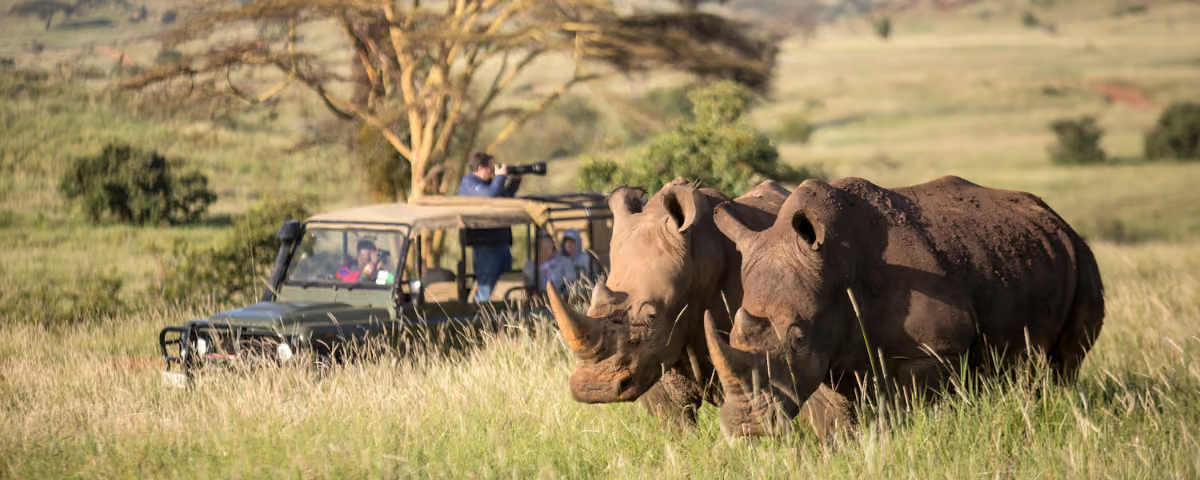
In South Africa’s dry north, a safari can also mean the opportunity to quite literally get up close and personal with the closest thing to a living dinosaur.
Marakele National Park is home to some amazing conservation work, focusing on the critically endangered black rhino and near-threatened white rhino. Those lucky enough to find themselves there get the chance to participate in vital, hands-on rhino protection, helping with everything from micro-chipping horns and ear-notching to fitting tracking collars and collecting samples. The experience ends with a behind-the-scenes tour of the conservation operations room to reveal how the data you’ve helped collect directly informs rhino protection strategies. This adds an intimate knowledge of conservation to your safari that few others get to experience, and helps you see the bigger picture about these chubby unicorns.
The all-female guardians of Botswana's wilderness
In Botswana, there is no shortage of conservation and community initiatives that our partners are engaged in, from community buses to school children camps. One of note is the all-female Green Griffons Rangers. A model that has shown great success across Africa, this project provides employment and training for twelve local women who are tasked with protecting the expansive 7,000 hectare Mkambati Nature Reserve.
Not only are they dedicated to safeguarding wildlife through anti-poaching and de-snaring efforts, the Green Griffons Rangers also empowers rural women to take the lead in protecting the landscapes they call home. Not only does this provide an environmental benefit but the independence and voice this brings local women also encourages future changes in equality.
Peruvian journeys to the roots of civilisation
There's no better way to change commercial tourism in Peru than with a more grounded and real experience. Sitting at an altitude of 3,225 metres, Choquecancha is a breathtaking remote village deep in the Peruvian Andes. If you are wanting to discover the real culture of the lost Incas, you can see it for yourself on an expedition that supports the local community’s ability to preserve their thousand-year-old Andean culture. These journeys function on the principle of Ayni, a Quechua word describing the essential Andean principle of reciprocity.
In addition to spanning the Andes, Machu Picchu, and Ollantaytambo, this 12-day expedition also allows you to discover ancient cooking techniques, join hands-on traditional weaving and textiles workshops, and learn about native medicinal plant remedies, to name just a few items. It starts at AUD$6,477 per person and can either form an entire trip or have elements be incorporated into a more usual itinerary.
Securing a future for Namibia's desert giraffe
Most people are surprised when they learn that giraffes are now one of the most threatened species in Africa. Referred to as the ‘Silent Extinction’, over the past 35 years giraffe populations have plummeted by nearly 30%, and today there are only about 117,000 giraffes left in the wild across the continent.
In Namibia, our partners work closely with the Giraffe Conservation Foundation to finance protective strategies, including the relocation and collaring of the desert-dwelling Angolan giraffe. This species is faced with extreme landscapes and ongoing environmental pressures, a unique double hit of challenges. They also lead specialised conservation safari experiences that explorers can partake in, assisting researchers on the ground with tasks like darting, tracking and attaching tags.
Witness, learn and contribute to Antarctic whale research
Every March, the Antarctic Peninsula becomes a prime feeding ground for whales, from humpbacks to Antarctic minke whales. If you’re really lucky, you might also spot the endangered blue whale or even a sperm whale. This density and diversity of whale species then become the perfect opportunity for scientific research, and marine biologists and naturalists try to use this time to capture as much data as possible for their research.
Onboard a 13-day expedition in March 2027, guests get a front row seat to scientific researchers assessing whale presence by capturing their vocal activity underwater. Your presence on this trip allows them to travel and conduct research that is usually cost prohibitive, and you can learn from the very best. And if that’s not convincing enough, it’s also worth mentioning that this itinerary also crosses the Antarctic Circle, starting from only AUD$21,900 per person.
Supporting coexistence between people and wildlife in Zimbabwe
Zimbabwe's Hwange National Park is one of our favourite locations, and we encourage many of our explorers to experience its wildlife population. But for locals living alongside such an abundance of wildlife, it can also bring real challenges.
For example, elephants can wander into villages, devastating an entire season's crops overnight. Lions and hyenas have also been known to prey on livestock. Left unaddressed, this can mean that wildlife are then targeted and killed to prevent further losses. Our partners go to great lengths to help mitigate this conflict, from helping replenish supplies after wildlife-related losses, to setting up deterrent systems to prevent recurring issues. This means that every Hwange safari we send you on provides capital to help protect local livelihoods and safeguard the park's wildlife. This is alongside the other benefits that tourism brings, from funds for local schools and even something as simple as boreholes. In fact, many of our partners even offer guests an opportunity to witness this in action, grounding your safari experience with its real-world community and conservation benefits.
The hardest part of this Dispatch was choosing what programs to include. There are a wealth of options around the world run by good people doing good things. And primarily, this is all funded by explorers choosing to visit their pocket of the world, directly contributing financial means to run these programs. A trip somewhere is good for you as the traveller, but there is no reason it can’t also be good for everyone else. This is the real benefit of your visit, and it means the good times will last long beyond you leave.