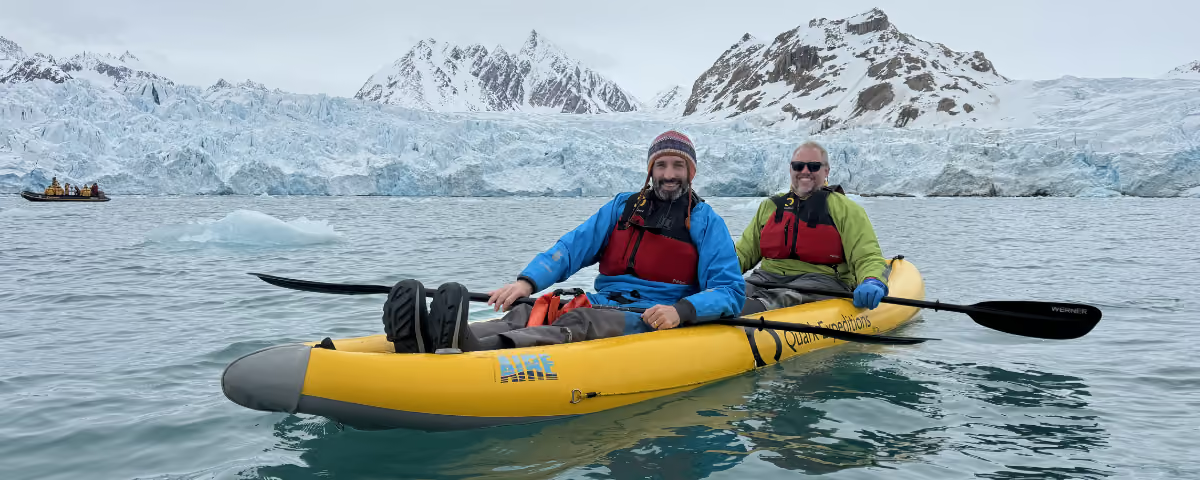
We sit there, gently floating on the icy water in our kayak. Nearby a massive glacier drops occasional chunks of ice, a thunderous roar following as the sound wave belies the real distance. A minke whale occasionally comes to the surface amongst the ice, looking like an oversized dolphin patrolling the fjord.
Yet despite all of this, one thought fills my mind.
“Why does this place sound like a giant bowl of Rice Bubbles?”
There is a cognitive bias known as the Dunning-Kruger effect.
Essentially, the Dunning-Kruger effect is when people, with low knowledge or expertise, overestimate their own skills. In other words, the less you know, the more you think you know. The inverse is also true, known as ‘imposter syndrome’. The Dunning-Kruger effect isn’t a marker of low intelligence, but rather low expertise in a subject. It’s also the reason everyone became immunologists during Covid and then became supply chain logisticians during the Hormuz Strait blockade.
For me, when it came to the subject of ice, I was pretty sure that I knew a decent amount. For background, I’ve lived on snow fields and I have seen ice many times around the world. I’ve also spent time in the Antarctic, and learned the difference between icebergs, growlers and bergy bits. In a previous job I even used to live-commentate the calving of an active glacier in Alaska (talk about improvisation) in between hosting ice carving demonstrations of local artisans. Fair to say, apart from having a resume filled with utter uselessness, I have seen ice before.
But, floating about in Svalbard high above the Arctic Circle, made me realise just how little I actually knew.
We headed out by zodiac from our base ship, Quark’s lovely Ultramarine, to do a spot of kayaking. In case you are wondering, we take the zodiacs to get some distance from the ship, and also to later use as a safety backup in case of an accident (or enthusiastic polar bear). Loading into a kayak with full dry suit and safety equipment, we quickly find our rhythm as we explore the nearby coastline. We spot birds feeding near the water surface and tried to pin down the whereabouts of that elusive minke whale. All while heading towards the glacial front, a blue-iced behemoth carving its way through mountains towards the water.
And it was here, in this northern heaven, that I was introduced to ‘Brash ice’.
Like a truly great actor, ice can play many characters. Brash ice is best described as being the debris of a glacier, comprised of fragments less than 2 metres wide. It covers the water like a frozen veil, and although you can push through it in a kayak, it does limit your pathways to do so. And, as it clinks together and cracks in the water in a gentle swell, it sounds like a bowl of Rice Bubbles. It snaps, it crackles and it pops.
A few days later, around 81 degrees north (and only around 500 miles from the North Pole), more ice characters introduce themselves. Again heading out on the kayak, we come across ‘Grease Ice’. This is the frozen soup as ice crystals begin to form on the surface of the water, and makes the ocean we paddle through look oily. We then meet its older brother, ‘Pancake ice’. This is formed when consistent movement (usually wave action) batters the grease ice and knocks off the corners. With splashes of water forming ridges around the edge, the ice forms into rounded pancake-style shapes. If it helps, think of it as looking like frozen lily pads.
Paddling through pancake ice is different, and is not too dissimilar from trying to move a straw through a Slurpee. You can get moving, but progress is slow and momentum is harder to establish. If you want an easy ride, kayak behind someone else in the clear water as they act like an icebreaker.
We eventually hit the ‘Pack Ice’. Pack ice is the most infamous version of polar ice, the giant sea ice landscapes that drift with oceanic currents. This pack ice floats with the currents and crashes onto itself, forming ridges and drifts. It looks utterly inhospitable. There is no kayaking here, you simply hit the edge of the ice and come to a dead stop.
Here, at eye level with the jagged edges of millions of tonnes of ice, you realise the immense challenge the early Arctic explorers faced. This is ice that is hard to sail through, but too loose to walk on. You can’t ride a sled here, or even drag a sled across the chunks of miniature ice mountains. This is ‘The Pack’, an alien landscape with a life of its own. Early explorers on both ends of the earth talk about ‘the pack’ in the same way one might talk about summiting Everest, or travelling space, or defeating a mythical monster. There is no conquering The Pack, there is merely surviving it. It has captured ships in its icy embrace and crushed them like toothpicks, or dragged sailors across through places unknown to meet awful, frozen ends. We aren’t going to beat it in an inflatable kayak. And even today, despite pushing the ship through miles of loosely formed pack ice utilising all forms of modern technology, there is a point where we have to admit defeat. Without an icebreaker we have no way of going further, as so we must retreat. And more importantly, we must retreat whilst we still can.
For me, that sense of retreat is the beauty of remote travel. It is, amongst other things, a humbling of the ego. It is the biting cold of the Arctic wind reminding me how fragile my life is and how frail I am in this environment. It’s the sense of scale when studying a fjord or glacier, knowing that this has existed for eons before me and will exist long after I am dust. For me especially, it’s the joy of discovering how little I actually know about this world I live in. It might be utter ignorance about climate, or maybe bird life cycles, or about cultural traditions and histories. All of it, all this new information, all downloading into seemingly gluttonous neurons and writing new chapters in my life’s encyclopedia. And who knows, maybe even one day lethargically regurgitated at a pub trivia (or to regale a bored teenage child).
After all, when faced with the infinite beauty of Svalbard and the northern Arctic, who knew that this journey of discovery would instead begin with brash ice sounding like Rice Bubbles?