Hidden in a remote corner of a remote conservancy, in remote Namibia, lies a window to the past. It’s here we find ourselves, kneeling in the dirt, squinting at a rock.
We are staying at nearby Camp Doros, in the famed Damaraland area of Namibia. Sandwiched between the iconic game park Etosha to the north, the sand dunes of Sossusvlei to the south and the Atlantic Ocean to the west, this region is a little otherworldly. Dry, rocky and (to the untrained eye) pretty barren, it is actually home to numerous species of animals. It is even a haven for desert-adapted species like elephants and black rhinos. Within this hot and very seasonal environment, however, lie landscapes that seem like something originating from a Star Trek episode. For example, there is Burnt Mountain, a mountainside that is black as pitch and looks like it has been extruded from the depths of hell. As you drive across this conservancy you’ll encounter flat-topped mesas, dry river beds, open moonscapes and mountains made of rocks that look like the toy collection of an infant giant.
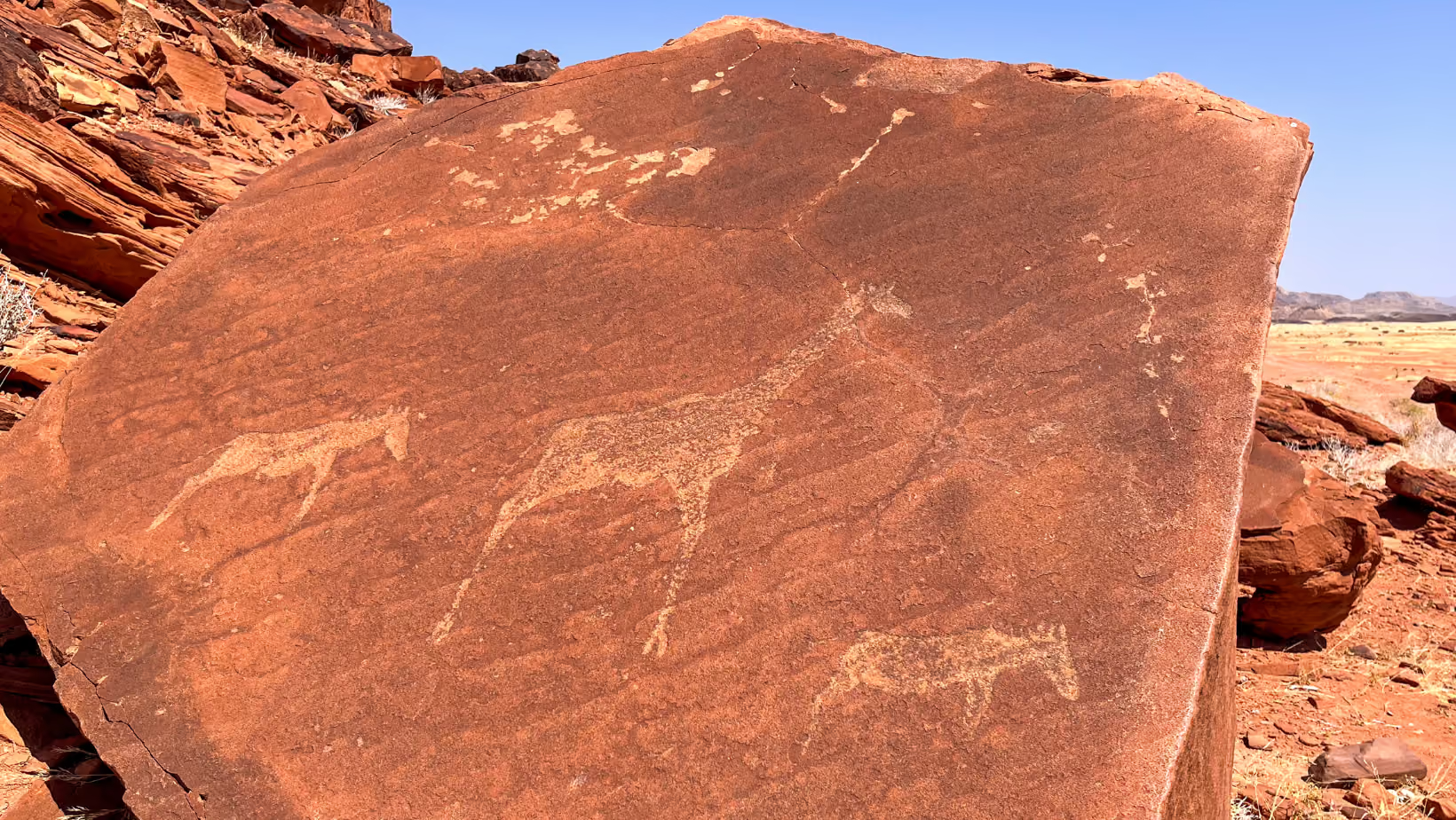
And then, in the middle of this ‘nowhere’, lies a piece of human history. Here, on the rock face of a flat stone, are ancient rock carvings. And in the nearby mountains lies an even bigger secret trove of history.
Let’s go back a bit, somewhere between 2,000 and 6,000 years ago, to this same valley. This valley is timeless, with landscapes that haven’t changed in millennia. And moving through these landscapes are the nomadic San people, better known to many as the Bushmen. As you can still see today by spending time with them, they are intimately aligned with their environments. Moving across what is now Namibia and Botswana (and even around Angola, Zimbabwe and Zambia), they covered vast distances as they survived, and thrived, from the land. As they made their way through these biomes and followed nature’s cues, they would have encountered a huge diversity of landscapes and wildlife. So just like people do today, in their downtime, they record their lives through art. Creativity and artistic expression, whilst often seen as an unnecessary skill for survival, are the one medium that ensures that the stories of humanity survive through the ages. It is the survival of the people, just not in their physical form. All of the wealth, the politics and power, the harvests and heartache, all are forgotten unless captured in some form of art. Be it poetry or performance, written word or music, this is what remains to tell future generations about who they were. And here, thousands of years later, it still remains.
In this case, in the form of rock carvings and paintings.
We leave our vehicle at the rock carving, an image of an antelope and a giraffe shining in the sun. Led up the mountain by our guide, we discover more carvings on a broken stone slab as we go, the images having rotated 90 degrees when the stone cracked and fell to the ground. And onwards up the mountain we go, until we arrive at a rock overhang. As we duck under the overhang into the small cave-like area, we see a scattering of red markings on the rock wall. Quickly we can make out some pictures. There are the obvious ones, like some short human figures with distinct male and female forms. There are also some larger humans, although seemingly drawn without a head. And then there is an ostrich, and a skinny-looking antelope. It all seems pretty simple and rather straightforward.
But it's as our eyes adjust to the darkness out of the glare that we really begin to see the images. The red pigment they used hasn’t faded over time, so we still see that clearly, but the white pigment they painted with has begun to wear off. So, as those white areas slowly come into focus, the images show some deeper meanings. The skinny antelope is actually a springbok, complete with a faded white underbelly that escaped first glance. The ostrich has details on the wings that reveal themselves, and nearby we spot the image of a kudu, the ears a dead giveaway to the species. These are animals the Bushmen knew very well, so each image is amazingly accurate in its representation. You can tell by the colouring and the accuracy of each drawing. This also works in reverse. At nearby Twyfelfontein, a renowned rock painting site, you can see paintings of penguins and seals. These are animals the Bushmen must have encountered in their wanderings, but far less frequently, so their images are less detailed than others.
At this unstudied and unknown site, with some patience, other images slowly begin to jump out at us. We feel like archeologists exploring an ancient tomb or deciphering hieroglyphics. Painted in small dots, we can now see the image of an elephant, the forehead and ears now visible in perfect clarity. Kneeling in the dirt, we then discover a resting cheetah, lying on its side. Bit by bit, image by image, an artist from a few thousand years ago begins to make their presence felt. Or artists, as different artistic styles between the images soon became clear. This must have been a resting place used by generations, with each generation adding to the shared mural of their surroundings.
But this is where modern technology also helps bridge the gaps between what they painted and what we can see. Taking a photo on our phones and using a special phone app to filter the colour spectrum, we make some big discoveries. For example, the dot-painted elephant isn’t alone. Removing the red spectrum, we can see, tucked underneath its trunk in barely perceptible white pigment, is a small baby elephant. The ‘headless’ figures also spring to life. Suddenly they are no longer headless, but instead have stunning white portraits in great detail. We can see these ancient faces as clear as day. As this is an unstudied collection of paintings and carvings, all we have are theories about their origins and meanings. But we can surmise from the height of these figures compared to the others, and the facial features of the portraits, that these are of the taller Bantu people (found in Southern Africa) that the San would have traded with. The landscapes they saw, the animals they encountered and the people they met were all later added to their artistic encyclopædia, painted into this cave. And once you see these hidden images, it is impossible to unsee them.
We take it in turns to scan the rock wall with the phone, taking photos of new areas of rock, and revealing new discoveries. We talk in low tones, completely unnecessarily as there is no one else around for many miles, but almost like we are in a museum. It has the same feeling, and we are speaking with reverence for the past. We don’t know the exact people who made this artwork, but we can understand the people who made it. People are people, whether it be divided by borders or by many centuries.
We could have spent hours there, but we had elephants to track and our very patient child was slowly reaching the end of their tolerance. But, as the sun beat down outside and temperatures climbed in the high 30s, the similarity of human life wasn’t lost on me. Here we were, sitting in the shade, telling stories and talking about animals and art, whilst a child amused themselves climbing on nearby rocks. I have no doubts that thousands of years ago when these pictures were painted, and in all the years to come after, other families did the same thing at this place. I can’t help but feel, as we eventually drag ourselves out, that I am leaving a friend’s house. It’s a strange feeling, utterly divorced from reality, but the feeling is clear as day. And as we make our way down the mountain to the vehicle, I can almost imagine the conversations going quiet once again.
That is, until new friends visit again.